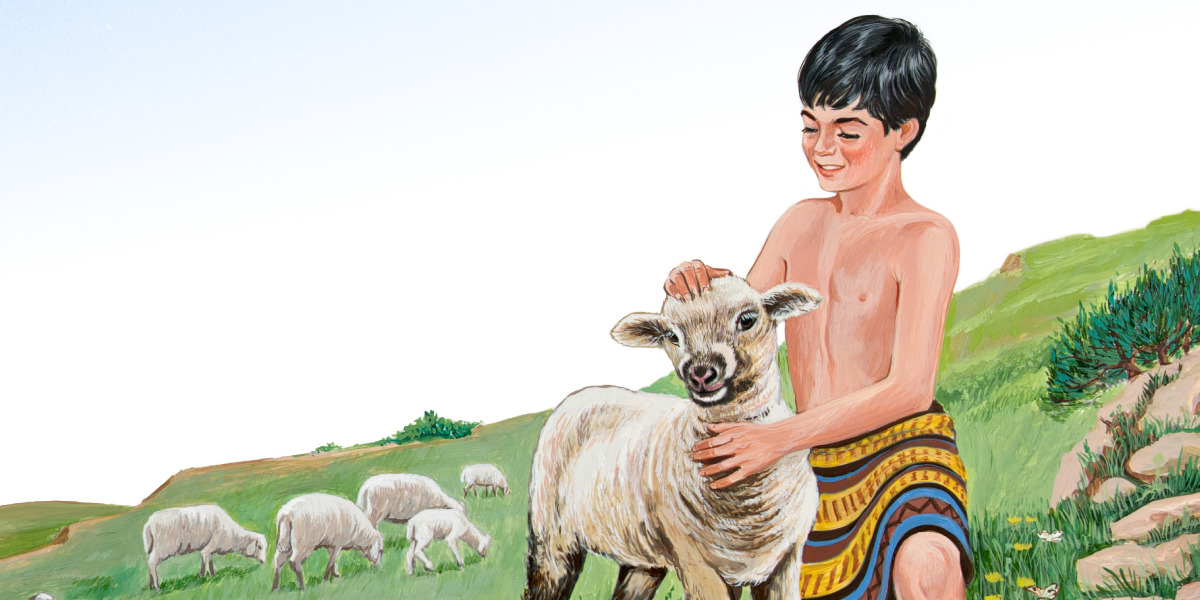
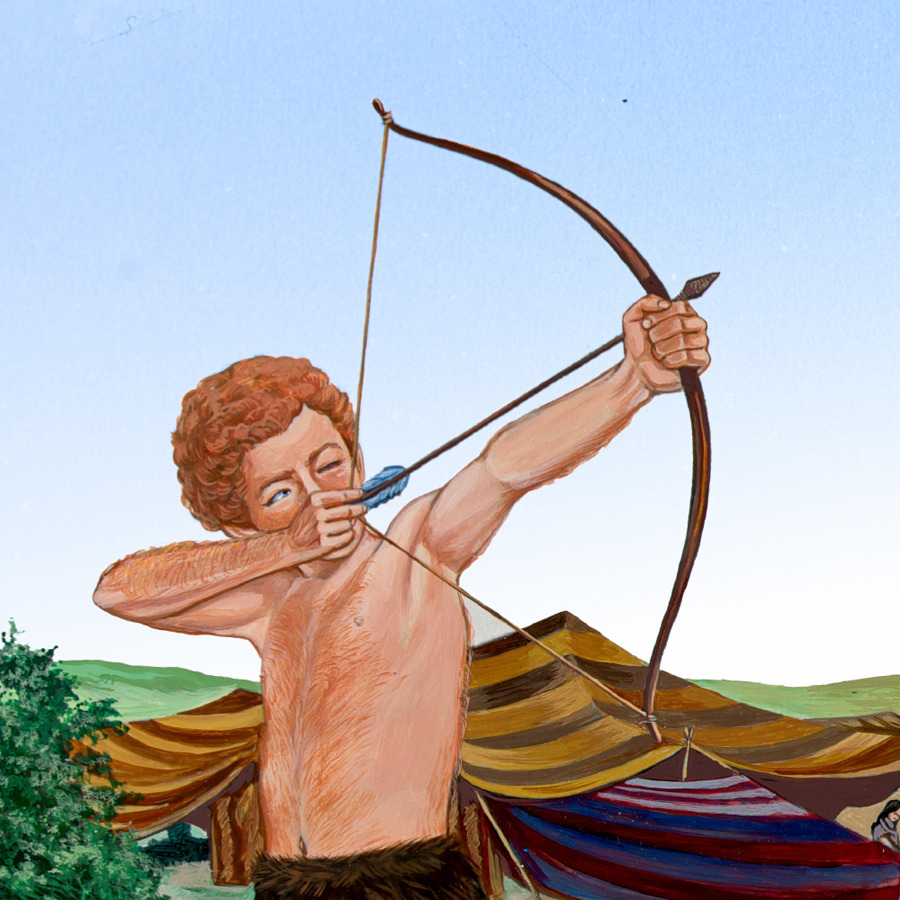
LOS dos muchachos que ves son muy diferentes, ¿verdad? ¿Sabes cómo se llaman? El cazador es Esaú, y el muchacho que cuida las ovejas es Jacob.
Esaú y Jacob eran hijos gemelos de Isaac y Rebeca. Al padre, Isaac, le gustaba mucho Esaú, porque era buen cazador y traía a la casa alimento para que la familia comiera. Pero Rebeca amaba más a Jacob, porque era tranquilo y apacible.
El abuelo Abrahán todavía estaba vivo, y podemos imaginarnos cuánto le gustaba a Jacob oírle hablar acerca de Jehová. Abrahán al fin murió a los 175 años, cuando los gemelos tenían 15 años.
Cuando Esaú tenía 40 años de edad se casó con dos mujeres de la tierra de Canaán. Esto puso muy tristes a Isaac y Rebeca, porque estas mujeres no adoraban a Jehová.
Entonces, un día pasó algo que hizo que Esaú se enojara mucho con su hermano Jacob. Vino el tiempo en que Isaac iba a dar una bendición a su hijo mayor. Porque Esaú era mayor que Jacob, Esaú esperaba recibir esta bendición. Pero ya Esaú había vendido el derecho de recibir la bendición a Jacob. También, cuando los dos muchachos nacieron, Dios había dicho que Jacob recibiría la bendición. Y esto es lo que pasó. Isaac dio la bendición a su hijo Jacob.
Después, cuando Esaú supo esto, se enojó con Jacob. Estaba tan enojado que dijo que iba a matar a Jacob. Cuando Rebeca supo esto, se preocupó mucho. Por eso, le dijo a Isaac su esposo: ‘Va a ser terrible soportarlo si Jacob también se casa con una de estas mujeres de Canaán.’
Por eso Isaac llamó a su hijo Jacob y le dijo: ‘No te cases con una mujer de Canaán. En vez de eso, ve a la casa de tu abuelo Betuel en Harán. Cásate con una de las hijas de su hijo Labán.’
Jacob obedeció a su padre, y enseguida empezó su largo viaje a donde vivían sus parientes en Harán.
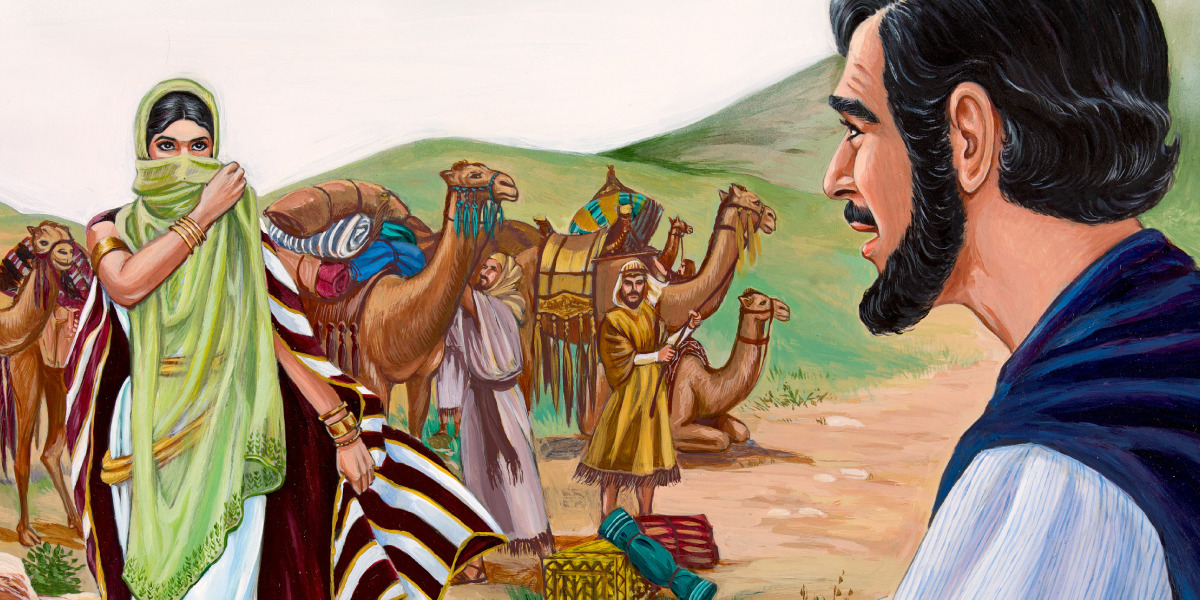
¿CONOCES a la mujer de esta lámina? Se llama Rebeca. Y el hombre al cual ella va es Isaac. Ella va a ser la esposa de él. ¿Cómo pasó esto?
Bueno, Abrahán, el padre de Isaac, quería una buena esposa para su hijo. No quería que Isaac se casara con una de las mujeres de Canaán, porque aquella gente adoraba a dioses falsos. Por eso Abrahán llamó a su siervo y le dijo: ‘Quiero que vuelvas a donde viven mis parientes en Harán y consigas una esposa para mi hijo Isaac.’
En seguida el siervo de Abrahán tomó consigo diez camellos e hizo el largo viaje. Cuando se acercaba al lugar donde vivían los parientes de Abrahán, se detuvo en un pozo. Era casi de noche, cuando las mujeres de la ciudad iban a sacar agua del pozo. Por eso el siervo de Abrahán dijo en oración a Jehová: ‘Que la mujer que consiga agua para mí y los camellos sea la que tú escoges para ser esposa de Isaac.’
Pronto vino Rebeca para conseguir agua. Cuando el siervo le pidió de beber, ella le dio agua. Entonces ella fue y consiguió bastante agua para todos los camellos sedientos. Trabajó duro, porque los camellos beben muchísima agua.
Cuando Rebeca terminó, el siervo de Abrahán le preguntó el nombre de su padre. También preguntó si él podía pasar la noche en la casa de ellos. Ella dijo: ‘Mi padre es Betuel, y hay sitio para ti en casa.’ El siervo de Abrahán sabía que Betuel era hijo de Nacor, el hermano de Abrahán. Por eso se arrodilló y dio gracias a Jehová por llevarlo a los parientes de Abrahán.
Aquella noche el siervo de Abrahán le dijo a Betuel y a Labán, el hermano de Rebeca, por qué había venido. Ambos dijeron que Rebeca podía ir con él y casarse con Isaac. ¿Qué dijo Rebeca cuando le preguntaron? Dijo que sí, que quería ir. Por eso, el mismo día siguiente montaron en los camellos y empezaron el largo viaje para volver a Canaán.
Cuando llegaron, era de noche. Rebeca vio a un hombre andando en el campo. Era Isaac. Él se alegró de ver a Rebeca. Sara, la madre de él, había muerto solo tres años antes, y él todavía estaba triste por ello. Pero ahora Isaac llegó a amar mucho a Rebeca, y fue feliz otra vez.
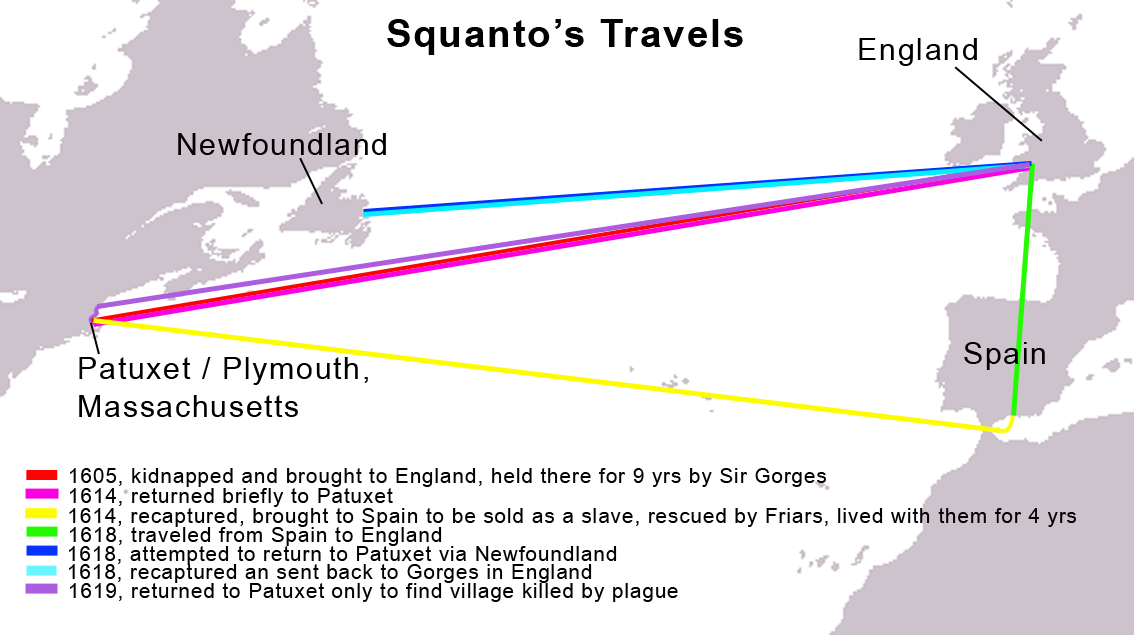
The day I had longed for for so many moons was finally here. I was almost home! I stood on the bow of the ship watching as the shoreline came into view. My heart pounded with anticipation! I could almost hear the shouting, drumming, and dancing, and taste the great feast my family would serve to welcome me home. I couldn’t wait to see their precious faces and tell them about my second kidnapping five years ago in 1614.
Squanto is Kidnapped
You see, my troubles began in 1605 when I was just a young teenager, living in what later became known as Massachusetts. I was kidnapped and taken to England, where I learned to speak English and taught the white man about our land in America. After nine long years, Captain John Smith brought me home. However, only days later, I was kidnapped a second time.
An evil ship commander, Captain Hunt, tricked me and 26 other Indians who had gone onto his ship to trade with him. He chained us in the bottom of the boat and took us across the ocean and sold us as slaves. But God was able to use Captain Hunt’s evil for (my) good. A good man, a monk, bought me and took me to Spain.
He told me about the new god-man named Jesus. Despite the monk’s kindness, I still longed to be with my people, the Patuxet tribe.
The compassionate monks sensed my heartache and helped get me back to England, where I found passage on a ship to North America. When we stopped in Maine, I met Samoset, a Native American like myself. His Indian clothes and moccasins made me even more homesick. I greeted him with a raised hand to show friendship. “I am Tisquantum,” I said. “The English call me Squanto. I am returning to the Patuxet tribe, no longer a slave.” I was glad for Samoset’s friendship in the weeks to come.
Squanto Returns Home
At last, our ship pulled into the harbor. I slid down the rope over the side of the ship and into the waiting canoe. The land of my childhood looked deserted, but I thought I knew why.
They probably saw this English boat coming and hid in the woods. I’ll call my family. They will answer.
All the familiar places were still there. I ran into the woods calling my father and mother, anticipating a joyful reunion.
No answer.
I called the familiar Indian whistle, the one that sounded like a frightened bird.
Still there was silence.
My heart began to thump. I raced through my land, searching wildly for my tribe.
Samoset’s birdcall beckoned me to him. I found him squatting over something in a clearing. I gasped at what I saw there. Human bones and skulls were scattered on the ground.
Samoset got up and walked away, disappearing into the woods. I searched until sunset, finding more bones, a pair of moccasins, and a few arrowheads.
Finally Samoset returned with the worst news. The chiefs of the next village had told him of the Great Plague of 1616. The entire Patuxet tribe had died in the plague. There hadn’t even been time to honor the dead with a proper burial.
My stomach contracted into a tight ball of pain and my chest heaved as I stumbled into the darkness. I fell to my knees as I realized I was the only one of my family still alive.
Why? Why was I even born? To help the English? To break my mother’s heart? Does the God of the English care about the Indian?
A New Purpose for Squanto
For weeks I wandered the land of my childhood, sad and alone. Finally, I joined the Wampanoag tribe. Kind chief Massasoit welcomed me, but it didn’t help. No place felt like home without my family.
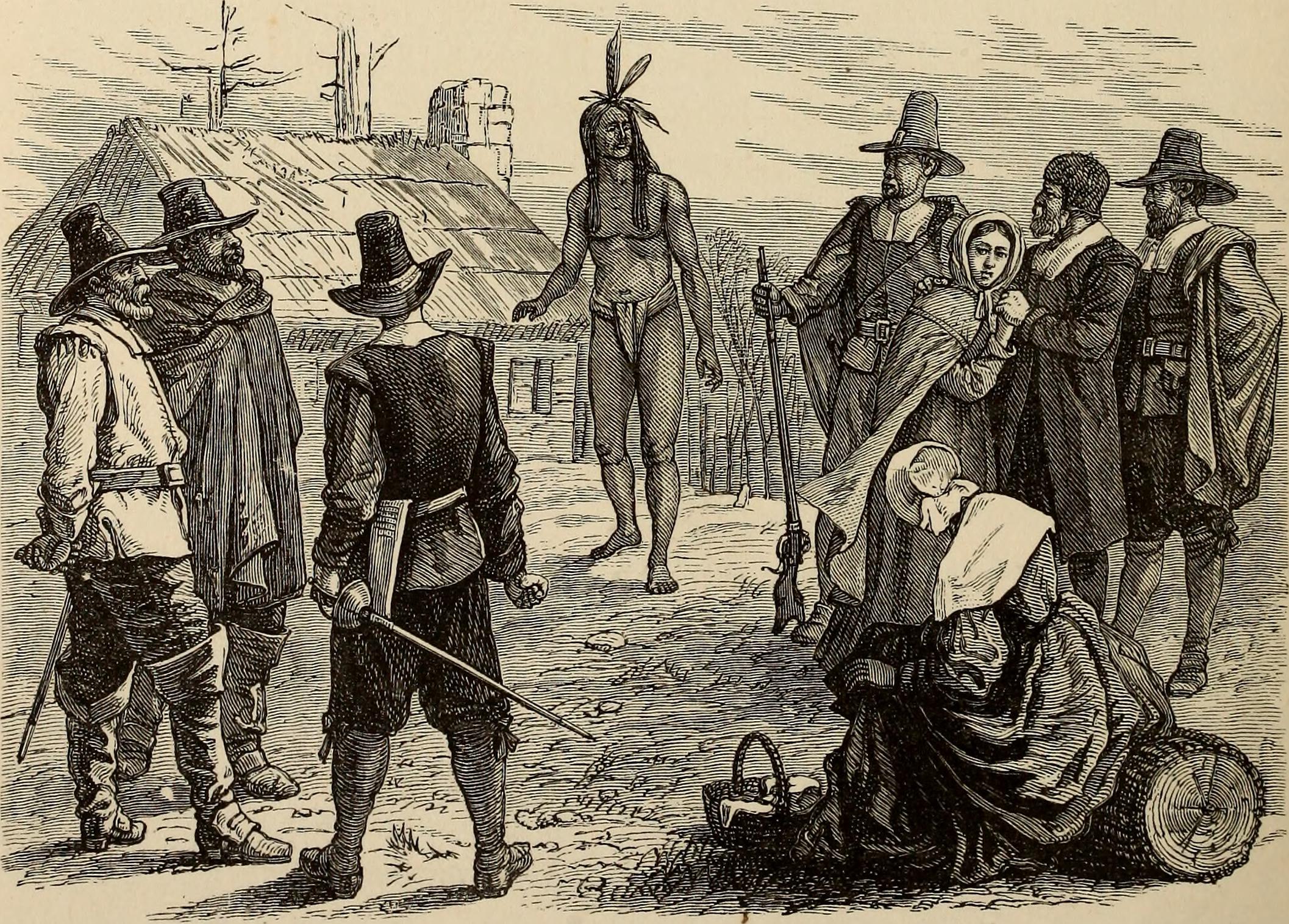
“Squanto, have you heard?” called Samoset one day. “The English have come again and have settled in the land of the Patuxet. They are peaceful but barely surviving. They need an interpreter. Do you want to go meet them?”
I wasn’t sure I could trust them, but I went along. They sure were surprised to find that we spoke English! Before we left, Governor John Carver asked me to stay with his people and interpret for him whenever he wanted to talk to “King Massasoit,” as he called our chief. I agreed to stay. The pilgrims were hungry and had no idea how to survive in our great land. For the first time in years, I felt like I belonged. Could it be that God’s purpose for my life was now unfolding?
I smiled at the wonder on their faces when I returned from the river one evening with my arms full of eels. At sunset, we cooked them over an open fire. The boys couldn’t wait to try catching their own fat, juicy eels the next day.
We searched the edge of the river for a good shallow place and I stepped into the cool water, squishing mud between my toes. Stomping left and then right brought the first eel to the surface. As his head poked through, I plunged my hands into the water, aiming for his belly. Seconds later, I pulled him squirming out of the water.
“Hurray!” shouted the boys, eager to take a turn. That evening every boy had at least two eels to bring home to his family.
“Squanto, I can’t thank you enough for showing the boys how to catch eels,” said Governor Carver as we ate supper together. “What other food can we find here?”
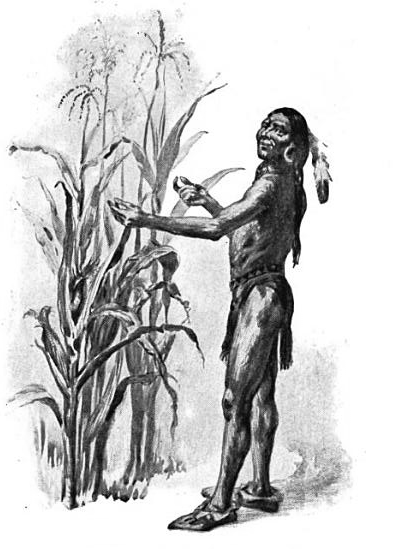
“April is corn-planting month,” I replied. “You must wait until the bud of the white oak has reached the size of a mouse’s ear before you plant corn. Then you’ll have enough to last you through next winter.”
Governor Carver leaned forward, a gleam in his eye. “You know how to plant enough food to last a whole winter? Maybe our people won’t starve this year thanks to you, Squanto.”
Could this be why I was born? Finally, I had a purpose in life. Finally, God had shown me where I belonged.
Governor Carver passed away that year and didn’t get to see the corn growing taller than the men. The new governor, William Bradford, was so pleased with the food supply in the fall of 1621 that he invited Chief Massasoit and the Wampanoags to a great feast. Bradford declared it “a day of public Thanksgiving.” It started with prayer and lasted three whole days.
As we ate and played games, I thought about my new life. My family had died, but the Pilgrims were my family now. The Pilgrims and their God, Jesus, adopted me–and I adopted them, too!
Make It Real! Questions to make you dig a little deeper and think a little harder.
Despite all his negative encounters with various English explorers, Squanto was able to trust and even help the pilgrims. How do you think he was able to get past his hurt feelings to do something positive?
Squanto’s story is similar to the story of Joseph in the Bible. Both were taken from their family and sold as slaves. Both used their experiences to help others. How are their stories similar and how are they different?
Do you think the pilgrims would have survived if Squanto had not befriended them? Why or why not?
What types of things do you think the Indians and the pilgrims were thankful for on that first Thanksgiving?
Suggested reading:
Squanto and the Miracle of Thanksgiving by Eric Metaxas (Tommy Nelson Publishers)
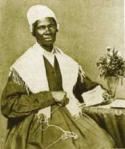
Born to Slavery “Momma, I’m hungry and cold and my whole body hurts!” complained young Isabella at bedtime.
“Yes, child, I know you hurt. But remember, our master is better than some others. At least we are together.”
Isabella had heard all this before, and she really was thankful to be with what remained of her family. It was just that when her stomach growled and her body ached from yet another beating, she often forgot.
“But Momma, it’s just as if God has abandoned us here in this cold, miserable cellar.” The words of doubt poured from the young girl’s mouth even as tears streamed down her face.
Mau Mau Bett knelt down to Isabella’s mat and began to rub her sore, bruised body. “No child. God will never leave you. He cares about you, and you can always count on Him to guide you.” Mau Mau Bett tried her best to encourage her children in their faith. But even so, now and then little Isabella found her mother alone and singing sadly, “How long, O Lord? How long?” She too wished for the day she would be released from the burden of slavery.
Talking to God Isabella worked hard on her special project. After dragging in the willow branches, she wove them and stacked them together. It was there in her very own little hideout that she began to talk to God.”He hears me,” Isabella told her mother one day as they worked side by side in the house.
“Yes, child, He does.”
Isabella looked shyly at her mother. “Momma, I hear Him, too.”
Mau Mau Bett paused in her dusting. “How do you hear Him?”
“I just do. It’s like He talks to me.”
Talking to God helped young Isabella cope with the fear that lurked around the edges of her life. Throughout her childhood, she was sold repeatedly, experienced regular whippings, and often had too little to eat. At times she believed she could bear no more pain or fear.
Around 1817, Isabella “married” for the second time. Since slave masters had complete control over slaves, their marriages were not recognized by law. Slaves would pledge themselves in marriage until “death or distance” kept them apart. Isabella’s first husband had been sold away from the nearby farm, but her new husband, Thomas, belonged to the same master as Isabella. Together they had one boy and three girls, but their union was not to last either. Not only did the master sell Thomas, but he also sold her son Peter and illegally sent him across the state lines.
“I’ll get him back, I will,” Isabella vowed through her tears of pain.
Her mistress mocked her determination. “You don’t have the money to get Peter back.”
Isabella took a deep breath, confident in spite of the fear that filled her. “That’s not a problem. God has plenty of it.”
A Great Escape An illiterate runaway slave with no money didn’t have much chance of surviving, but Isabella decided she had no choice. In 1826, faith overcame her fear as she set out on her journey. “I’m going to trust you, God, every step,” she prayed. “You tell me where to go and how to get there, and I’ll follow you.”
God led her to a Quaker couple called the Van Wagenens, who listened to her problems and decided to help.
“We’ll buy your freedom,” they said. “And we know where Peter is, and we can help get him back.”
“How can I thank you enough?” she asked.
“Give your thanks to God!” they said. Isabella’s eyes widened. She had never met nice white people. Because of their kindness, Isabella let go of the intense bitterness she had felt for many years. Her past was filled with the misery caused by her white masters, and hatred had filled her heart. But now, God used the Van Wagenens’ kindness to show her another way.
A New Challenge “But I have no training!” Isabella protested. “No experience.”
“I’ll give you both,” replied a popular evangelist of the African Methodist Episcopal Church who saw a gift in Isabella. “I think the Lord has blessed you with a gift of speaking. You must use your gift to help spread the word.”
Although Isabella had known about the Lord from a young age, she hadn’t accepted him as her Savior until she was 30. Now in her 40s, she was being asked to go forth in ministry. Isabella accepted the call, but before she began, she wanted a new name, to represent her new life. As she told her friend, Harriet Beecher Stowe:
“My name was Isabella, but when I left the house of bondage, I left everything behind. I wa’nt goin’ to keep nothin’ of Egypt on me, an’ so I went to the Lord an’ asked Him to give me a new name. And the Lord gave me Sojourner, because I was to travel up an’ down the land, showin’ the people their sins, an’ bein’ a sign unto them. Afterwards I told the Lord I wanted another name, ’cause everybody else had two names, and the Lord gave me Truth, because I was to bring the truth to the people.”
When they heard her news, Sojourner’s children became alarmed. Traveling evangelism was uncertain enough, but it was ten times worse for a poor, uneducated black woman. They shot objections at her:
“Where will you stay?”
“How will you travel?”
“Women don’t speak in public, Mama!”
“Especially not former slaves!”
Sojourner held up a hand. “This is God’s doing, and He will protect me like an umbrella protects us from the sun an’ the rain.”
She began her work speaking in 1843, traveling mostly on foot. She often began her messages by saying, “Children, I talk to God and God talks to me!” She learned to rely on God when trouble broke out, as it did when she attended a revival meeting one day in 1844.
“Break up this here meeting, or we’ll set fire to your tents!” The angry mob yelled at the speaker. Shaking with fear, Sojourner slipped away to hide in a corner of a tent. Torches flashed dangerously close, as she listened to her pounding heart.
“Hasn’t God always been faithful to me? He is the same yesterday, today, and forever. He will be faithful in this as well.” With renewed courage, she rose from the ground, straightened her dress and emerged from the tent. Gathering her nerve, Sojourner climbed a hill and began to sing a hymn to her Lord.
Rioters and worshippers stopped to listen. Then Sojourner’s worst fears seemed about to come true. The protesters lunged forward, surrounding her with their sticks and clubs. “Why do you come about me with clubs and sticks?” she asked.
“We ain’t goin’ to hurt you,” several men shouted. “We just want to hear you sing!” The rioting ceased as Sojourner lifted her voice in praise of God, who had once again protected her in danger.
Sojourner did not have the benefit of all the Christian education we have today. But, in spite of that, her deep faith led her to trust God in all circumstances.
Make It Real! Questions to make you dig a little deeper and think a little harder.
Even though they were slaves living in a basement with little food, Isabella’s family still thanked God. Can you think of a time when you thanked God, even though things were going badly?
Isabella made a special place where she could pray and listen to God. Have you ever thought of setting aside a special place for prayer? What kind of place would you choose?
“Sojourner” means one who stays in a place for a short time. Why was this a good name for Isabella to choose? If you could choose a new name to represent your Christian life, what would you choose?
Sojourner trusted God through many different trials. Can you think of a time when it was hard for you to trust God?
Suggested reading:
Sojourner Truth by Susan Taylor-Boyd (Gareth Stevens Children’s Books)
Sojourner Truth and the Voice of Freedom by Jane Shumate (The Millbrook Press)
A Picture Book of Sojourner Truth by David A. Adler (Holiday House)
LOT y su familia vivían junto con Abrahán en la tierra de Canaán. Un día Abrahán le dijo a Lot: ‘Aquí no hay bastante tierra para todos nuestros animales. Vamos a separarnos, por favor. Si tú vas para un lado, yo iré para el otro.’
Lot miró la tierra. Vio una muy buena parte del país que tenía agua y mucha buena hierba para sus animales. Era el Distrito del Jordán. Por eso, Lot mudó a su familia y animales allí. Al fin hicieron su casa en la ciudad de Sodoma.
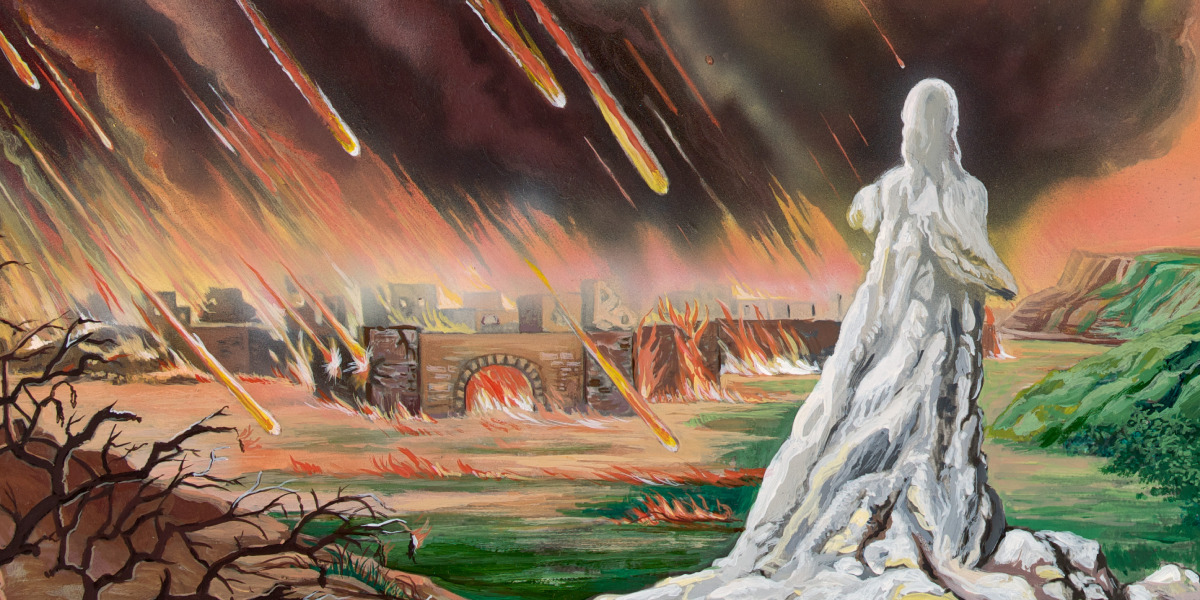
La gente de Sodoma era muy mala. Esto molestaba a Lot, porque él era bueno. Dios también estaba molesto. Al fin, Dios envió a dos ángeles a avisarle a Lot que iba a destruir a Sodoma y la ciudad cercana de Gomorra porque eran malas.
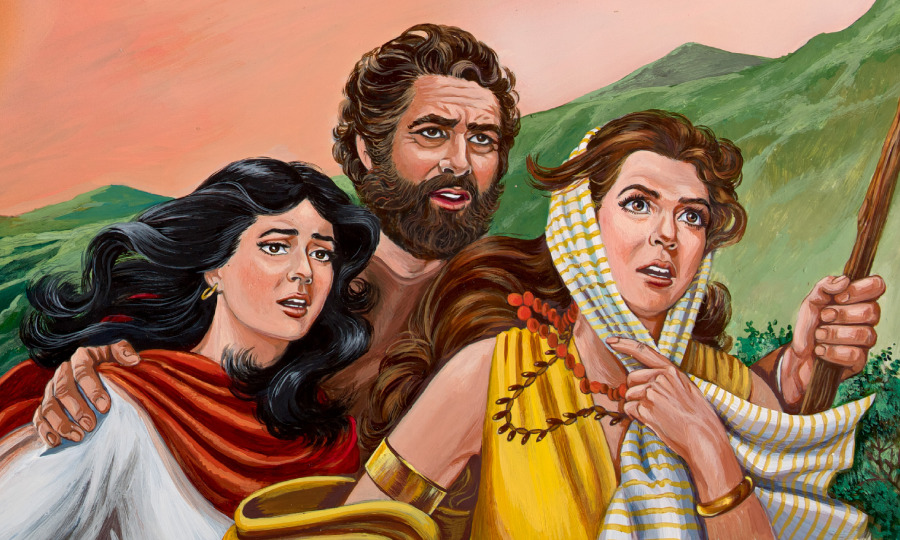
Los ángeles le dijeron a Lot: ‘¡Aprisa! ¡Toma a tu esposa y tus dos hijas y sal de aquí!’ Lot y su familia se tardaban, y por eso los ángeles los tomaron de la mano y los sacaron de la ciudad. Entonces uno de los ángeles dijo: ‘¡Corran por su vida! No miren atrás. Corran a los montes, para que no mueran.’
Lot y sus hijas obedecieron y huyeron de Sodoma. No se detuvieron ni un momento, y no miraron atrás. Pero la esposa de Lot desobedeció. Cuando se habían alejado algo de Sodoma, se paró y miró atrás. Entonces la mujer de Lot se convirtió en un pilar de sal. ¿Puedes verla en la lámina?
De esto podemos aprender una buena lección: que Dios salva a los que le obedecen, pero los que no le muestran obediencia pierden la vida.
Génesis 13:5-13; 18:20-33; 19:1-29; Lucas 17:28-32; 2 Pedro 2:6-8.
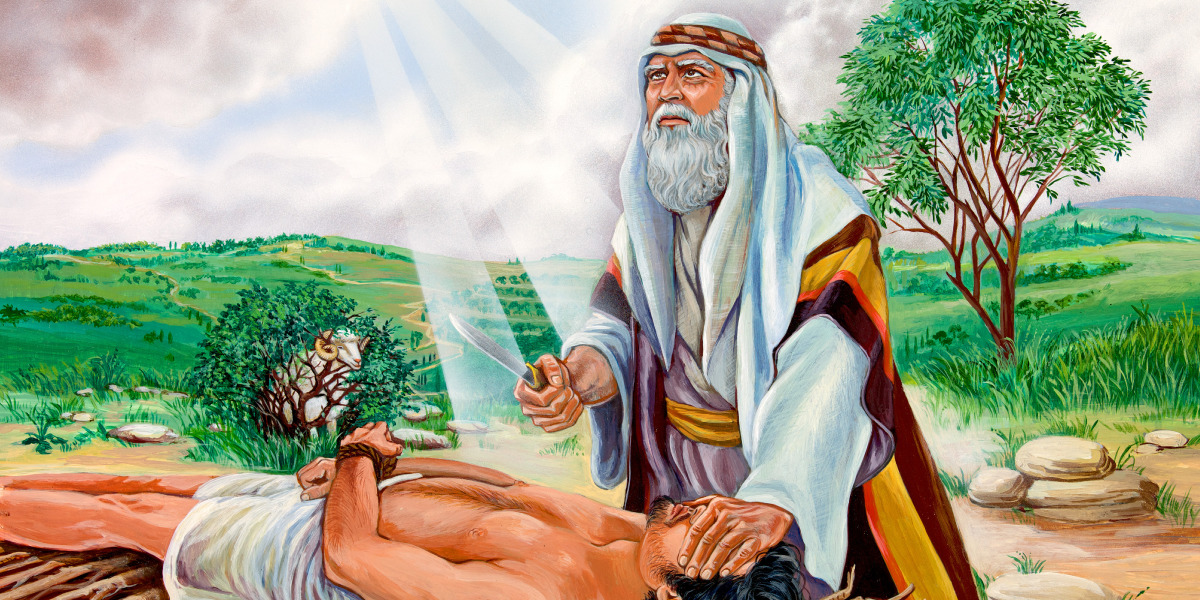
¿PUEDES ver lo que está haciendo Abrahán? Tiene un cuchillo, y parece que va a matar a su hijo. ¿Por qué? Primero, veamos cómo consiguieron su hijo Abrahán y Sara.
Recuerda, Dios les prometió que tendrían un hijo. Pero eso parecía imposible, porque Abrahán y Sara eran tan viejos. Pero Abrahán creía que Dios podía hacer lo que parecía imposible. Por eso, ¿qué pasó?
Después que Dios hizo su promesa, pasó un año entero. Entonces, cuando Abrahán tenía 100 años y Sara 90, tuvieron un nene llamado Isaac. ¡Dios había cumplido su promesa!
Pero cuando Isaac tenía más edad, Jehová probó la fe de Abrahán. Llamó: ‘¡Abrahán!’ Y Abrahán contestó: ‘¡Aquí estoy!’ Entonces Dios dijo: ‘Toma a tu hijo, tu único hijo, Isaac, y ve a la montaña que te voy a mostrar. Allí mata a tu hijo y ofrécelo como sacrificio.’
¡Qué triste puso esto a Abrahán, porque Abrahán amaba mucho a su hijo! Y recuerda, Dios había prometido que los hijos de Abrahán vivirían en la tierra de Canaán. Pero ¿cómo podría pasar eso si Isaac estuviera muerto? Abrahán no entendía, pero todavía obedeció a Dios.
Cuando llegó a la montaña, Abrahán ató a Isaac y lo puso sobre el altar que había hecho. Entonces sacó el cuchillo para matar a su hijo. Pero en ese mismo momento el ángel de Dios llamó: ‘¡Abrahán, Abrahán!’ Y Abrahán contestó: ‘¡Aquí estoy!’
‘No le hagas daño ni nada al muchacho,’ dijo Dios. ‘Ahora sé que tienes fe en mí, porque no has retenido a tu hijo, tu único hijo, de mí.’
¡Qué gran fe tenía Abrahán en Dios! Él creía que nada le era imposible a Jehová, y que Jehová podía hasta levantar de entre los muertos a Isaac. Pero en verdad Dios no quería que Abrahán matara a Isaac; hizo que una oveja se enredara en arbustos cerca y le dijo a Abrahán que la sacrificara en vez de a Isaac.
PASARON muchos años. Los hijos de Noé tuvieron muchos hijos. Y sus hijos crecieron y tuvieron más hijos. Pronto hubo mucha gente en la Tierra.
Una de estas personas fue un bisnieto de Noé llamado Nemrod. Él era malo y cazaba y mataba animales y hombres. Nemrod también se hizo rey para gobernar a otras personas. A Dios no le gustaba Nemrod.
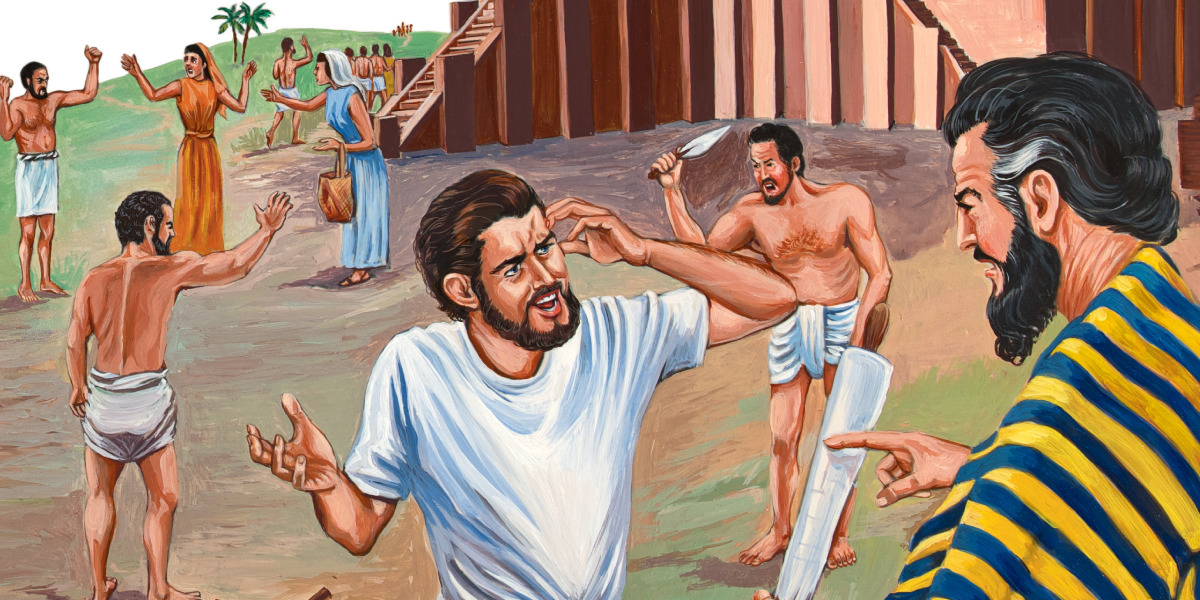
Toda la gente de aquel tiempo hablaba un solo lenguaje. Nemrod quería mantenerlos juntos para él poder gobernarlos. Por eso, ¿sabes lo que hizo? Les dijo que hicieran una ciudad y una gran torre en ella. En la lámina los ves haciendo ladrillos.
A Jehová Dios no le agradó este edificio. Él quería que la gente se fuera de allí y viviera por toda la Tierra. Pero ellos dijeron: ‘¡Vamos! Hagamos una ciudad y una torre tan alta que su parte de arriba llegue a los cielos. ¡Entonces seremos famosos!’ Querían honor para sí, no para Dios.
Por eso Dios hizo que la gente dejara de hacer la torre. ¿Sabes cómo lo hizo? Hizo que de repente las personas hablaran diferentes lenguajes, en vez de uno solo. Ya no se entendían los unos a los otros. Por eso su ciudad llegó a llamarse Babel, o Babilonia, que quiere decir “Confusión.”
Ahora la gente empezó a irse de Babel. Los grupos que hablaban el mismo lenguaje se fueron a vivir juntos en otras partes de la Tierra.
William Wilberforce: The Little Man Who Stopped a Big Evil
“William, come quickly! We need to leave now, or we’ll be late for our meeting with Reverend Newton.”
It was 1768 in England, and nine-year-old William hurried downstairs where his Aunt Hannah and Uncle William had a carriage waiting.
“I’m coming,” William mumbled as he climbed into the carriage. He wasn’t happy about wasting his afternoon visiting a preacher. Still, John Newton had been a slave ship captain many years ago. Maybe he would have some interesting stories to tell.
When they arrived at Mr. Newton’s house, William hung back shyly.
“And who is this young man?” John Newton asked.
“This is our nephew William. His mother sent him to live with us after his father died,” replied Aunt Hannah. “We love him like a son!”
“William, I am very pleased to meet you. Do you like cake?” asked the pastor.
William smiled and nodded while his aunt responded laughingly.
“Of course he does! He may be small for his age, but it seems like all he does is eat!”
“Well, William, let’s have tea and cake in the garden and get acquainted.”
William followed Mr. Newton into the garden and was soon asking questions about his adventures at sea. Reverend Newton patiently indulged the boy’s curiosity before steering the conversation in a different direction.
“Slaving may sound like a grand adventure, but it wasn’t. I’ve repented of my sin of helping to capture and sell fellow human beings. Slavery is evil. God loves all people the same, William.”
“Even the slaves?”
“Oh, yes, even the slaves. Even you, William!”
By the end of the day, William and John Newton were friends. After that, William went to see John Newton preach and was soon convinced that slavery was a great wrong. He wrote a letter back home to his mother.
Dearest Mum, I heard John Newton preach in church last Sunday. He has had an interesting life as a slave ship captain, but now he realizes slavery is sinful. He has asked for God’s forgiveness for the way he has treated the people of Africa. He said he wants to treat all people with more love. I am thinking about committing my life to Jesus. I’d like you to come with me to hear Mr. Newton preach sometime. Your loving son, Willy.
William’s mother, Elizabeth, was not happy to hear that her son was interested in religion. She considered the belief in a personal relationship with Jesus unnecessary and beneath her social standing. She immediately informed William’s grandfather, who shared her concern.
“You’re right, Elizabeth,” he told her. “If that boy wants to be a Wilberforce and inherit any of my money, he’d better steer clear of that kind of religion.”
Aunt Hannah was devastated. “Please don’t take him, Elizabeth,” she and Uncle William begged. They had no children of their own and had grown to love William. But Elizabeth could not be persuaded.
WILLIAM SEES THE LIGHT Back in his mother’s care, young William soon forgot about his introduction to faith. At age 21, he was elected to the British parliament, which is a part of government. He was soon known for his great talent in public speaking. He had a good job, lots of friends, and invitations to the best parties.
William loved being the life of the party by mocking the town’s Christians–especially the ones who were just too religious. William’s crowd of intellectual friends agreed that serious religion was quite beneath them.
In 1784, 25-year-old William and his family took a vacation to France. William invited along his friend Isaac Milner but hoped Isaac wouldn’t talk about his Christian beliefs. But, with so much time together, discussions of faith were bound to happen. Isaac patiently answered William’s questions and even gave William a book on faith. Within a few months, William was on his knees speaking to God. He had become a committed Christian, and his life’s purpose would soon become clear.
SLAVERY, A FLAGRANT EVIL William looked out his window onto the deserted cobblestone street. Pulling his cloak around his face, he darted out the door. No one must know about this secret meeting. The men in Parliament just wouldn’t understand. William quickened his pace and slipped down a side street. Glancing once more in both directions, he knocked on the door and was beckoned inside.
“Why Mr. Wilberforce, you’ve become a fine young man. I’ve heard your name about town.” John Newton still remembered meeting William nearly 20 years before. “Now how can I help you?”
“Reverend Newton, I’ve come to seek your counsel. I’ve recently begun to understand the faith you spoke of when I was just a boy. I’ve become a Christian and I want to do the right thing!”
“Go on,” replied the older man patiently.
“It’s just that I’ve prayed, but I’m still not sure what God wants me to do. Maybe if I want to serve God, I should quit my job as a politician.”
“Ah, I think I understand,” said Newton. “Mr. Wilberforce, God has given you a great gift for speaking, and He’s given you a position of influence.
“Well, thank you, sir. So, should I become a preacher or perhaps an evangelist?”
John Newton looked hard at the young man. “Mr. Willberforce, God has already placed you right where He needs you. God needs people in all sorts of occupations to do His work. Just think of all the government officials who will listen to you but would scoff at a preacher like me! God has a great work for you. The road will be long, but He will use you.”
With that, William felt at peace. His purpose became even more focused as he later wrote, “God Almighty has set before me a great object: the suppression of the slave trade.”
A LIFETIME OF LABOR William worked tirelessly toward this goal. He fought to educate lawmakers on the evils of slavery and to abolish the practice. Year after year he wrote new laws, but they were always voted down. Finally, after 20 years of work, a law was passed making it illegal to capture Africans and sell them as slaves. But what about those who were already slaves? Their release would take William 26 more years. He refused to quit even when frail health threatened to end his life or when his closest allies gave up.
In July 1833, the 73-year-old William Wilberforce was sick in bed. He was awakened by loud footsteps in the hall. As his bedroom door flung open, he slowly turned his head towards the commotion.
“William, have you heard? Your years of effort have finally succeeded. Parliament passed the Emancipation Bill! Slavery has finally been abolished in the British Empire!”
William Wilberforce raised his head slightly and gave his friend a weak smile. Though his body would never recover, his heart was leaping for joy, thinking of the many slaves who would finally be released to live in freedom.Make It Real! Questions to make you dig a little deeper and think a little harder.
What job would you like to do when you grow up? How can God use you in that job?
What laws in your country do you think need to change?
England passed laws to abolish slavery in 1833, after many years of debate. What event lead to America’s abolishing slavery in 1865? Why do you think it took longer for America to free slaves?
Do rules or laws help people to behave better or tempt them to do wrong?
Suggested reading:
Fendall, Lon. Heroes of the Faith, William Wilberforce. Barbour Books, 2002.




.1200w.tn.png)






 Jesus is the name