
Halloween: In the Land of the Shadow

Halloween: In the Land of the Shadow

NINTH-CENTURY IRELAND
Fifteen-year-old Antonius walked along the woods near the monastery as twilight shadows wrapped themselves around him. “Lord, I know you’ve called me here, but I didn’t know it would be this hard. People in Ireland are so different from those in Rome.”
Antonius heard noise coming from the nearby village, but he continued to pray. “Lord, tonight is October 31, All Hallow’s Eve. It is a night to remember the faithful believers of the past. But I also want to honor them by living as they did and sharing your love with those who don’t know you.”
A sudden movement in the bushes startled Antonius. A loud shriek pierced the air as a hefty stick swung at his head.
Antonius ducked quickly and grabbed the weapon. “What are you doing?” he yelled.
“I…I’m not afraid of you!” the youngster stuttered, but his chattering teeth gave him away.
His sense of danger having passed, Antonius calmed down. “Nor should you be,” he said.
“But you’re a g-ghost!” the boy stammered.
“Certainly not! Why would you think that?” Antonius asked the boy.
DARKNESS ALL AROUND
The boy forgot his manners. “You talk funny.”
Antonius laughed. “I’ve just arrived from Rome. I’m studying at the monastery to be a monk. Now what has you so jumpy?”
“Tomorrow is new year’s,” explained the boy. “The spirits come out tonight, and I’m looking for them!”
“The young monk looked thoughtful. “My name is Antonius, and tomorrow is a special day for Christians, too. It’s All Saints’ Day, when we remember the people who died serving Jesus Christ.”
“I’m William,” answered the boy. “Is Jesus your god?”
Antonius answered with confidence, “Yes, Jesus is God, but He was also a man.”
William looked anxious. “Well, I’m sorry about nearly clobbering you.”
“All is forgiven,” Antonius said. “Give me the stick, and I’ll walk you back to the village.”
William agreed. “Sure, you can help me if we meet any spirits!”
Antonius gazed at the boy as their feet crunched fallen leaves. Flickering lights from the village beckoned, but he felt the darkness of some of the Celtic beliefs. “Lord, let your light shine into William’s heart.”
A LIGHT HAS DAWNED
In the village, people were dressed in ghoulish costumes. A pig squealed and ran in front of them. “At least it wasn’t a black cat,” William commented. “That would be bad luck.”
Antonius didn’t believe in luck. After a moment he asked, “Why are people dressed like the dead?”
“To confuse the evil spirits. We also leave food for them so they won’t hurt us.”
They came to a bonfire, and William stretched out his hands to warm them. “Bonfires help our loved ones find us so we can ask them about the future. Mother hopes my father’s spirit will visit tonight.”
Antonius thought of the saints he intended to honor the next day. Of course there were the great heroes, like the disciples themselves, but it was even more important to him to remember the saints of his own family—those who had shared their faith with him. How would his dear grandmother help this young man understand? “William,” he began. “On this night we Christians also honor our dead.”
“Do they visit you?” asked William.
“No, we don’t believe that, but we light candles to honor them. I want to live my life in faith like the great saints of the past.”
William looked confused, so Antonius tried to explain. “Jesus died for our sins on a cross. On the third day, he rose from the dead, and all who trust in Him will live forever in heaven.”
“Rose from the dead! See I told you!” answered William.
“No, not like that,” explained Antonius. “Jesus is in heaven, and all who believe in Him will go there too.”
“You mean they won’t roam around on the earth?” asked William.
“No, not at all!” answered the monk. “Say, why don’t you come by the monastery tomorrow and I can tell you more about Jesus and All Saints’ Day?”
William smiled. “Sure!”
“And William,” said Antonius, “leave the stick at home. I doubt you’ll need it!”
Before Christianity came to Great Britain, the Celtic people had a lot of pagan beliefs. In late fall, they thought the dead would visit them. It is believed that they left food on their doorsteps and built bonfires. Some even dressed like the dead and went house to house. This is how the tradition of “trick or treat” began.
In the third and fourth centuries, Christianity began to spread through Europe and into Great Britain. But even so, many of the pagan Celtic customs were still popular. Then, Christians removed the Pagan temples, but still Celtic traditions carried on.
Finally in the eighth century, the church decided to have a day to honor the great Christians of the past, on November 1. This is called “All Saints’ Day.” The word “hallow” means “to make holy or sacred.” Therefore, October 31 would be known as hallow’s eve to describe the night before the day to honor those great souls. That is where the name “Halloween” comes from. It is a night that can remind Christians that, rather than worry about evil spirits like others do, they can honor and remember the great Christian heroes of the past.
HALLOWEEN IN THE U.S.A.
For the first 200 years of American history, Halloween wasn’t observed. When the Irish came in 1840, they brought along an old legend about a man named Jack. The story goes that Jack couldn’t go to Heaven because he kept all his money for himself. He was not allowed in Hell, because he kept playing tricks on the Devil. The legend says Jack was ordered to roam about with a lantern lit by a live coal. Though “jack o’ lanterns” could be made from turnips, potatoes, or beets, there were so many pumpkins in America that the Irish used them.Make It Real! Questions to make you dig a little deeper and think a little harder.
- The word “hallow” means “to make holy” or “to honor as holy.” How can you keep Halloween a holy day?
- Who are the people that have helped you grow in faith? How might you honor them on All Saints’ Day (November 1)?
- Are there Christian history heroes you find inspiring? Who and why?
- Are there parts of Halloween that you find scary? Look up I John 4:4. How could this verse give you comfort if you are afraid of any dark beliefs?
- How can you decide what Halloween activities, decorations, and costumes honor God and which do not?
Suggested reading:
- Stortz, Diane. Let’s Shine Jesus’ Light on Halloween. Standard Publishing, 2005.
- Higgs, Liz Curtis. The Pumpkin Patch Parable. Thomas Nelson Publishers
Gladys Aylward’s Long Road to China

Gladys Aylward’s Long Road to China
“Get off the train!” the Russian conductor shouted in words 30-year-old Gladys Aylward did not understand. But she could tell from his angry face that he wanted her to get up. However, Gladys did not move. She did not know everyone else was getting off the train because there was a fierce war going on up ahead. The train soon would be filled with only loud mouthed, bad-tempered soldiers. It was not a safe place for a woman traveling alone.
The Long Walk Back
When the train reached the next stop, the conductor forced Gladys Aylward to get off. She was the only non-military person left on the train. She now had to walk alone 30 miles back to the nearest city, through the woods in the cold, snowy night. This was only the beginning of her troubles, though. In the many hours to come, she would have almost no food to eat, nearly freeze to death, and barely escape being forced to become a Soviet military machine operator.
Gladys knew God wanted her to go tell the Chinese about Jesus, but why was it so hard for her to get there? Could it be God was getting her ready for even harder times?
Not Good Enough
Gladys Aylward grew up in London, England, in the early 1900s. As a teenager, she read a story about the Chinese that changed her life. She knew she must go tell them about God’s love.
Gladys failed missionary training school. The director told her she wasn’t smart enough to learn Chinese, and they would not accept her. But Gladys was determined. If the mission board would not send her to China, she would find her own way there.
To save money for her trip, Gladys went back to the only job she knew, being a maid. One day Gladys heard about an elderly missionary woman who was looking for someone to take over her work in China.
China at last!
When Gladys Aylward finally did arrive in China, she could not find the elderly missionary woman. Gladys was told she had moved to another village, a two-day mule ride into the mountains. So, Gladys hired a mule driver to take her there.
The missionary, 73-year-old Mrs. Jeannie Lawson, was surprised to see Gladys when she arrived at the village. She quickly put her to work repairing the big, old, rundown house that she lived in. The villagers thought the house was haunted. Mrs. Lawson wanted to turn the house into a hotel for the Chinese mule drivers. She would offer two things other hotels did not, dinner time Bible stories and beds without fleas. At first the mule drivers were afraid of the two white women they called “foreign devils.” However, once inside, they loved the Bible stories and news of the hotel spread quickly.
One day Mrs. Lawson slipped and fell from a second floor balcony. A few weeks later, she died. After Mrs. Lawson’s death, Gladys could not pay the hotel taxes. She was alone, without any money and was the only English-speaking person within a two-day mule ride. She did not know what to do. But guess what? God answered Gladys’ prayer in a way she did not expect.
For many years, the feet of Chinese girls were wrapped tightly at birth to keep them from growing big. The Chinese thought small feet were prettier. A new law said that all foot-wrapping must end. The town governor asked Gladys to be his official foot inspector.
At first, Gladys refused. She did not know why anyone would listen to someone they called “foreign devil.” However, she also had the governor’s okay to tell every villager about Jesus.
Gladys Aylward went to every village taking off foot bandages and telling Bible stories. The job paid enough to cover the hotel taxes and many Chinese became Christians.
Ai-weh-deh
Gladys did such a good job as foot inspector that when a riot broke out in the town prison, she was called again. This time the prison governor wanted her to calm the prisoners down. Afraid, Gladys prayed for help and then convinced the prisoners to put down their weapons. Afterwards she visited the prison every day and helped make their living conditions better. From then on, everyone called her Ai-weh-deh, which means “The Virtuous One.”
On another day as Gladys walked through the village, she saw an old woman trying to sell a dirty little girl. She could not bear to leave the girl with the woman who did not care about her. Gladys bought the girl for less than two dollars. This little girl was the first of almost 100 unwanted children who came to live with Ai-weh-deh.
Harder times
For many years, the Japanese had been at war with China. Gladys Aylward thought the village she lived in was so well hidden it would never be attacked. However, one spring morning, Japanese planes filled the sky. They dropped bombs, destroying the village and killing many people. Gladys, who was upstairs leading a prayer group, was knocked out as she fell to the first floor below. When she woke up, she went out to help others who were hurt.
The village was in shambles and dead bodies lay in the streets. Japanese foot soldiers were on their way to kill everyone who was still alive. Gladys, the orphaned children, and the villagers fled, finding safety in caves. As the Japanese continued to close in on them, she and the children walked many days without food but were able to catch the last train to freedom. Gladys became very ill. As soon as the children were taken care of, she fell into a coma. She was hospitalized for two months and almost died.
One Last Visit to England
Gladys decided to go back to England after many years in China. She had aged so much that her parents did not know her at first. The years in China had been hard on her. She often became confused. She thought she was still in China and would speak in Chinese. When she felt well enough she would speak at churches about the need for more missionaries to go to China. All the time Gladys missed China terribly. She knew she could not stay in England. Gladys Aylward was the first missionary to become a Chinese citizen. She went back to China and spent the rest of her life helping the Chinese.
Gladys Aylward became known around the world for the sacrifice she made to help the Chinese learn the way to God. You can see the story of her life in a movie called The Inn of Sixth Happiness.How well did you read the story?
Fill in the blanks with the correct answer. Put one character in each space provided.
- Gladys walked __ __ miles in the cold, snowy night.
- Gladys worked as a __ __ __ __ to save money for her trip to China.
- Gladys took care of unwanted __ __ __ __ __ __ __ __.
- Gladys and the children found safety living in __ __ __ __ __.
- The village was bombed by the __ __ __ __ __ __ __ __.
- Chinese girls had their __ __ __ __ bound.
- Gladys became a __ __ __ __ __ __ __ citizen.
Make It Real!
Questions to make you dig a little deeper and think a little harder.
- Gladys was determined to be a missionary even though she was told she wasn’t good enough. When people question your ability to do something that you sense God may be calling you to do, how do you respond?
- How did God provide for Gladys during times of need in her life?
- After Mrs. Lawson died, Gladys asked God what she should do next. How did God answer her prayer?
- How have you seen God provide for you or your family’s needs?
- Suggested reading:
- Gladys Aylward: Adventure of a Lifetime by Janet & Geoff Benge (Christian Heroes: Then and Now series, Ywam Pub.). Our favorite!
- Gladys Aylward by Catherine Swift (Women of Faith series, Bethany House Pub.)
Dietrich Bonhoeffer: The Cost of Discipleship

Dietrich Bonhoeffer: The Cost of Discipleship

Childhood Questions
“Don’t forget to say your prayers, Dietrich. You too, Sabine.”
“Yes, Mama,” answered the five-year-old twins in one voice. After final kisses and tuck-ins, Mrs. Bonhoeffer moved on to the beds of the other five children.
“I wish we didn’t have to go back to the city tomorrow,” whispered Dietrich when their mother was out of earshot. “I want to just live here in our vacation house!”
“Yes, I know. But if we lived here, we might get bored even if there’s lots to do.”
As Sabine began to drift off to sleep, Dietrich’s mind burned with a question. “Sabine, do you think heaven is like vacation?”
“I think so! I mean, everyone wants to go there!”
“But Sabine, we’ll be there forever– won’t it get boring just like vacations could?”
“I don’t know, Dietrich, but I know I want to go there! I hope God hears my prayers.”
“Me too, Sabine, me too.”
A Strange Announcement
“Dietrich is practicing his vocabulary again! He doesn’t even know what a “theologian” is. Of course he doesn’t really want to become one.”
Fourteen-year-old Dietrich became angry at his older brother’s mocking words. “Yes, I do know what a theologian is and yes, I do want to become one! It’s someone who studies all about God and the Bible and then teaches others. I’ve already been reading my Bible, and I want to learn all I can!”
“But Dietrich, you don’t even go to church! And besides, the church is selfish and corrupt.”
Dietrich had an answer for that argument. “In that case, I’ll reform it!”
He worked hard and eventually graduated as a teacher and pastor. As a real “theologian,” Dietrich even started attending church! But when he was given the chance to study in America for a year, he didn’t realize how much more he had to learn.
“What Happened in America?”
Dietrich watched in confusion as the New York City waiter left the table without taking Frank’s order.
“It’s just like I told you. They ignore me because I’m black. I’m sure you’ll get great service here, but they won’t even give me a glass of water,” explained Frank Fisher.
Dietrich’s confusion changed to action. “Frank, if they won’t serve you because of the color of your skin, then none of us will ever eat here again!” With that, the entire group left the restaurant in protest.
Walking home that evening, Dietrich was deep in thought. America was great, but why were people so prejudiced against blacks? Blacks were even attacked on the street for no reason. It was so unfair! God looked at a person’s heart, not the color of his skin!
Experiences like this taught Dietrich things he hadn’t learned in all his years of study. Living out his faith meant more than just attending church, reading books and teaching about God. Dietrich wanted to truly live out Jesus’ words in the Sermon on the Mount, “God blesses those who work for peace.” He returned to Germany determined to treat all people as equals and teach them that peace was always better than violence.
“What is different about you? What happened in America?” asked Dietrich’s friends when he returned to Germany.
His answer was simple. He told them, “I became a Christian in America.”
Little did he know that his decision to promote peace and equality would soon be put to the test.
Assassination Plot!
“Dietrich, we need your help. We’re going to do it– we’re going to assassinate Hitler!”
Dietrich was shocked speechless. He looked at his brother-in-law, Hans, as his mind raced. As a pacifist, Deitrich believed in peace, not violence. How could he consider killing someone, even a monster like Hitler?
Adolph Hitler was Germany’s leader. Hitler hated Jewish people so much that he wanted to get rid of them all. At first Jews lost their jobs, then their homes and businesses were destroyed. Eventually, many were crowded into filthy concentration camps and forced to work without enough food or warm clothes. Many Jews were sent to extermination camps, where they were killed just because they were Jews.
But Hitler and his Nazi party didn’t stop there. Anyone who opposed their evil plans would be treated like a Jew. Dietrich did all he could to show other Christians that they needed to stand up for the Jews, but many refused to listen. Now he was being asked to help kill Adolph Hitler.
“Hans, you know my beliefs! I hate what Hitler is doing, but I could never plot to kill somebody. I would be just like him! We’ve helped Jews escape and called the church to stand firm– surely that is the most we can do.”
“No, Dietrich. It’s not enough. Thousands of Jews are dying each week and Germany is being destroyed. Hitler must be stopped!”
Dietrich remembered the verse that had challenged him back in America: “God blesses those who work for peace.” He finally decided that removing the leader who was killing so many defenseless people would be the best way to work for peace. But the assassination attempt did not succeed. Dietrich, Hans and several other members of their family were arrested. He spent the last two years of his life in prison and concentration camps. Even under those awful conditions, Dietrich continued to challenge other Christians through his powerful writing. Those who were imprisoned with him looked to him as a pastor as they faced those dark days.
One Last Sermon
After five long days in the back of the transport truck, the weary prisoners were locked in a small schoolhouse for the night. The next morning was Sunday, so Dietrich led them in a church service. Following worship and prayer, Dietrich comforted the other prisoners with words from the book of Isaiah, “With his wounds we are healed.” As Dietrich finished his last prayer, the door to the schoolhouse burst open. Two evil-looking men entered and pointed at Dietrich.
“Prisoner Bonhoeffer. Get ready to come with us.” Just a few words, but everyone in the room knew what they meant. A hush fell over the little group as the room filled with a sudden tension.
As the prisoners said goodbye to Dietrich, he had time to whisper a last message. “Please don’t worry about me. This may be the end of my life, but it’s really just the beginning for me.”
Dietrich was executed on April 9, 1945, just three weeks before Hitler committed suicide and one month before the end of World War II. Dietrich’s most famous book, The Cost of Discipleship, continues to inspire and challenge Christians today, partly because Dietrich’s life showed that he knew and lived the cost of discipleship.Make It Real! Questions to make you dig a little deeper and think a little harder.
- How did Dietrich’s faith change through his time in America? What experiences have you had that have deepened your faith?
- Why do you think many Germans, even Christians, did not protest the Nazi persecution of the Jews?
- Have you ever needed to stand up for someone who wasn’t being treated fairly? What happened?
- Dietrich committed himself to work for peace, but eventually decided that it would be better to help kill one man than to allow that one man to kill many people. Do you think that was a good decision?
- Suggested reading:
- Hero Tales Volume II by Dave and Neta Jackson, (Bethany House Publishers)
- Heroes of the Faith: Dietrich Bonhoeffer (Barbour Books)
Empieza una vida dura

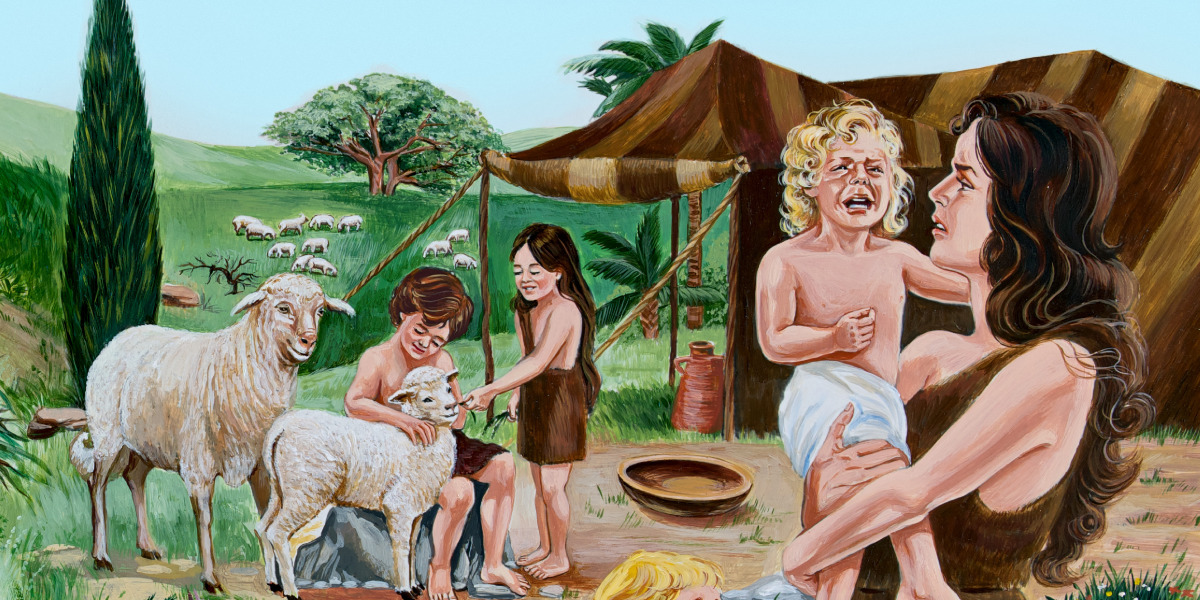
Empieza una vida dura
FUERA del jardín de Edén, Adán y Eva tuvieron muchos problemas. Tuvieron que trabajar duro para comer. En vez de árboles frutales lindos, vieron crecer muchas espinas y abrojos alrededor. Esto pasó cuando Adán y Eva desobedecieron a Dios y dejaron de ser Sus amigos.
Pero peor aún fue que Adán y Eva empezaron a morir. Recuerda: Dios les dijo que morirían si comían de cierto árbol. Bueno, el mismo día en que comieron empezaron a morir. ¡Qué tontos fueron por no escuchar a Dios!
Todos los hijos de Adán y Eva nacieron después que Dios echó a sus padres del jardín de Edén. Esto quiere decir que los hijos también tendrían que envejecer y morir.
Si Adán y Eva hubieran obedecido a Jehová, la vida hubiera sido feliz para ellos y sus hijos. Pudieran haber vivido para siempre en felicidad en la Tierra. Nadie tendría que haber envejecido ni haber enfermado y muerto.
Dios quiere que la gente viva para siempre en felicidad, y promete que algún día será así. No solo será linda toda la Tierra, sino que toda la gente será saludable. Y todos serán buenos amigos unos de otros y de Dios.
Pero Eva ya no era amiga de Dios. Por eso, no se le hacía fácil dar a luz hijos. Tenía dolores. Sí, en verdad el haber sido desobediente a Jehová le trajo muchísimo dolor, ¿no te parece?
Adán y Eva tuvieron muchos hijos e hijas. Cuando les nació su primer hijo, lo llamaron Caín. Al segundo hijo lo llamaron Abel. ¿Sabes lo que les pasó a éstos?
Génesis 3:16-23; 4:1, 2; Revelación 21:3, 4.
 Jesus is the name